I’m fairly new to the working interest owner side of mineral ownership and have inherited some working interests in the Spraberry Driver Unit, which is a very large unit in Midland, Glasscock, Reagan, and Upton counties. Pioneer and now Exxon/XTO is the Operator and we receive our JIBs and revenue checks from them. This interest goes back to the early 1950s. I’m at a loss on how the NRI being paid compared to the working interest percentage the JIBs is based on is ever in our favor. I know old wells have to be plugged. But now that new 3-4 mile long horizontals are being drilled in the unit, we expected our revenue to go up a bit as well as our JIB invoices. However, apparently the JIB invoice is based on a unit-wide working interest percentage, but the revenue we receive is on a tract participation basis and is reduced so many times it almost seems like it’s being paid more like an ORRI than an NRI when we have participated in successful new drills. I’ve gotten two different answers from the Operator and things don’t seem to add up at all. Does anyone have any insight into how this might work when you own working interest in a large unit? I have an oil and gas lawyer looking into things as well. But I’m trying to get as much knowledge as I can on the subject myself. The division orders I received listed the interest as NRI interest and had the exact same interest and description listed twice. One said 100 percent and the other said “ALL” under the “DO MAJ PROD” category. Under the current method the revenue is being paid versus the method the JIB costs are based on, these interests would never be profitable no matter how many wells they drill or even with higher oil and gas prices. So something has to be wrong somewhere possibly? Any help is greatly appreciated. The working interest cost basis percentage is also much lower than the NRI percentage so you would think it would be profitable at some point. We are sent AFEs asking to participate in new wells and agree to pay our share. But when we did and multiple successful wells were drilled and put online, our revenue check only went up $100 a month whereas each new drill our initial portion of the drilling cost was estimated around $2,000.
Is it an overriding royalty or a working interest? Do you have the original documents where your ancestor was granted the interest? Have you signed a new JOA? Like leases, they are the rules to the game when you have a working interest.
A WI is the lessee under a lease. As a simple example, Lessee owns 100% of the leasehold and pays all of the related costs (drilling, operating, repairs, etc). If the royalty rate is 15%, then the mineral owner receives 15% of the revenues as royalty. So the WI / Lessee is paid 85% of the revenues which will hopefully cover the costs and the royalties. The 85% is called NRI (net revenue interest) in the lease which will read as 0.85. If the lease is 10 acres and it is part of a 100 acre unit, then WI share of costs and revenues will be reduced by 10/100 to 10% of costs (JIB charge) and 8.5% NRI of revenues, or 0.08500. Where an operator pays on the tract basis, then the NRI will be 0.85 as 85% of the 10 acres. BUT the total gross revenues will be adjusted downward to the 10% share of unit acres. You come out the same, getting a higher percentage of lower allocated revenues. The JIB decimal will always exceed the real NRI, because the royalties are deducted from your WI. In your situation, there is the complication of high operating costs for the old unit, including well plugging and well reworking and well repairs, and falling volumes and oil prices. To get a better idea of how the economics works, you need to break the costs and revenues down to the individual wells - especially separating out the old unit from the new wells. It is possible that the unit costs exceed the unit revenues, as opposed to the new wells. Also, when you invest the $2,000 into a new well, the well may not payout for a year or more. Another question, how far in advance are the drilling costs being collected in relation to the time to drill and frac the new wells? Have all the wells been drilled and are producing? Or are some wells still waiting for fracs or shut-in until oil prices improve? You may want to separate the new wells onto separate spreadsheets to trace the drilling and production and revenues.
It’s a working interest and I have the full original JOA from around 1959 when it was unitized. We have not signed a new JOA and when I spoke with Pioneer/Exxon last year they told me that was the JOA they used.
This is really helpful information and I appreciate it. To answer some of your questions, I think I have done the math on the working interest and NRI just about any way it is supposed to work from the formulas I have seen on working interests and any weird way I can think of it being done from the old JOA. It never really makes sense.
The division orders show the NRI interest listed twice for each tract with the exact same legal description, and one line will say “all” and one line will say “100” under MAJ OF PROD. When I spoke with the operator’s billing department, they claimed all the revenue goes in a big “bowl” and then it’s divided up according to your tract participation factor, and then only after that does your NRI percentage come out of that much smaller total.
But the working interest JIB percentage used for invoicing is the same on everything unit wide for any expense or new well no matter what and makes no difference what tracts you own or tract participation factor. But yet we still are asked if we want to participate in new drills and sent information on them.
So it’s just strange to me how the revenue is divided down so many times to almost nothing before we get our NRI share. But I’m not as experienced on the working interest side as I am various royalty interest ownership.
Also, as you said, I do not know which wells are currently online and producing or paying out because that information is never provided on the revenue payment statements or anywhere else. Even with considering the plugging of numerous old wells in the unit, it has caused the JIB costs to of course go up, but only about equal to the revenue check or just under it.
It’s only been the new 8 wells over the last year that have driven up the JIB costs dramatically, which was expected, but we have seen about a $100 a month increase in revenue.
The Operator gave us access to Well Drive to see the new wells’ progress and well updates for the wells we agreed to participate in so far. So far they all look to be completed. Now whether they are all online or not I don’t know.
The revenue check statement shows very little details and doesn’t even show the wells on it. I was told we would never receive any division orders for the wells we choose to participate in either. Maybe it’s just a different set of rules due to a very old JOA.
But from what I have read and researched, nothing seems to follow the usual rules of working interest ownership except the JIB invoices. The billing department at Pioneer/Exxon was cooperative but didn’t seem to understand the working interest situation or at least just the person I spoke to at the time. She seemed to just keep describing how general royalty revenue is paid in a unit.
The land department has been helpful, so I may try and ask more questions there. I was just trying to gain as much knowledge of the situation myself before I went back to them to ask more questions.
Many companies have the JIB and check details available on EnergyLink, rather than sending the details in the mail. However, you go into ELink through a different portal than the plain royalty owners. That side of the site looks a little different. Then you can pick up the NonOp statements and JIB statements. Confirm with Pioneer/Exxon as to whether the detailed JIB and revenue statement can either be emailed to you or whether you need to go through ELink. Then you may need to talk with someone in ELink Support to sign up for the NonOp data statements. It is terrific that you have the old data. I do not think that JOA are updated or changed. Look through the JOA and see what the participation factor is for the tract(s) which include your lease. Do you have the lease to see what the royalty rate is? Were there any assignments in the history into your predecessor which reserved an ORRI? If so, they would further reduce your NRI.
I do use Energy Link, but I’m going to check and see what you’re saying about another portal to the revenue details. Right now I can go in there and get details on the revenue, but it’s not well related or anything except here is your production share, pricing, deductions etc., like a standard statement. I get more details on my straight royalty statements than this revenue check on the working interest provides. It’s strange. Exxon has had everything transferred over to XTO managing all billing and payments now that they have officially changed over from Pioneer and it’s a mess. So far I haven’t even received a January JIB statement. I have an email in to their JIB department about it.
That is a really good point about the ORRI since these interests are so old. My grandfather and great-grandfather were oil men. My grandfather originally had the lease with two partners in the 50s. Then when it was unitized a new operator took over as far as I can tell. So obviously over the years as people have passed away or transferred their interests there could be some ORRI assignments I’m not seeing. Do you think it would be worth it to have a Landman look into all of this since it’s fairly complicated and the ownership goes back so far? My predecessors were sometimes great with records and other times very lacking depending on the time periods.
I do have the old lease from around 1951 where my grandfather was working with partners as operator from what I can tell. Again, I could be interpreting that incorrectly. After that all we can find filed in public records as far as leases is just that there was a JOA for working interest owners in a Unit that occurred around 1960. Then of course various assignments over the years and decades as people passed and interests moved to descendants etc. That makes me wonder if I’m missing something which is very possible and a Landman could find a lot of these answers and missing pieces for us.
This is confusing. First, does the downloaded revenue statement only have one line for all income without citing a well or unit name anywhere? So the horizontal wells and unit are combined as only one total volume, gross sales? Or are you talking about the check stub attached to the check which only lists a summary one-line?
Second, does it list NRI as type of income or ORRI or list two lines which is one for ORRI and one for NRI? Is it possible that your income is separated into two parts - NRI and ORRI - and that only ORRI is on this statement? Is your NRI income being netted against the JIB well costs?
Sorry it is confusing and I probably wasn’t very clear on the revenue statement explanation either. So the actual revenue statement details show the name of the Unit and says Working Interest as the type of interest. I haven’t seen anything that shows a payment specifically for an ORRI or NRI. Only the WI working interest. It shows the Tract numbers that our interest involves in the Unit. Then it shows our share of the production and revenue after being divided down by our Tract participation factor and then it takes our NRI amount out of that resulting amount. That is how it was explained to me. Whether that is the correct method for calculating it or not I am not sure. It’s honestly a bit of a weird format for a revenue statement in my experience. But again I’m used to dealing with RI or ORRI interests. Let me see if I can crop a screenshot of a few lines of the statement and just blackout personal info to show you. Because I know it’s confusing and it’s hard to explain as well.
Ok, it’s not a great screenshot of the statement details, but I cropped part of one for an example of what the check statements are showing. This is off one from EnergyLink.
I do not think our revenue is being netted against any expenses since we receive monthly JIB invoices and they are very detailed and show our share of any expense incurred for every well in the entire Unit. So they’re definitely billing us separately for the Non-Operator WI expenses. I don’t know if the screenshots of a part of the check statement help, but I figured it was worth a shot in case anything looked off to someone more experienced with working interests.
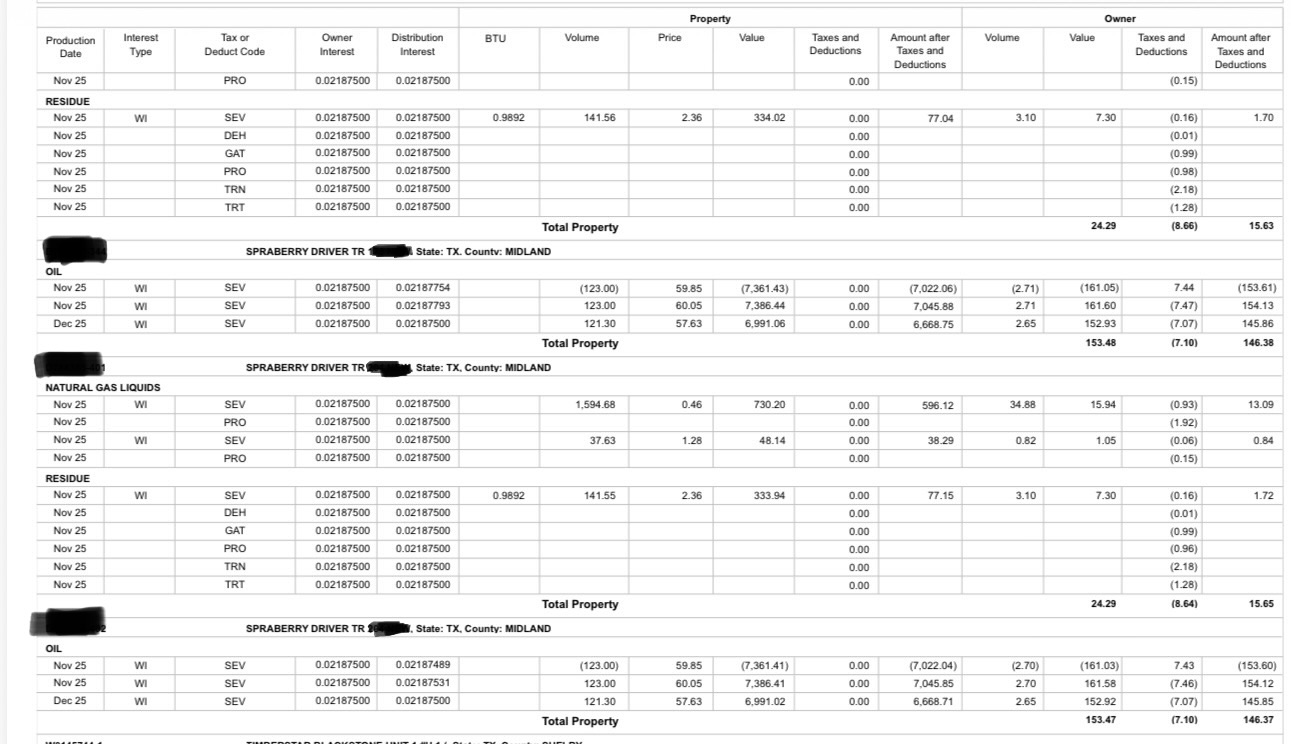
You do not own an ORRI and so are not paid on ORRI. You are a WI and so not paid a RI (royalty interest). The WI is your NRI based on the tract factor in the unit. Hard to tell from the limited detail, but the unit volumes and sales may be allocated evenly on a per-well basis among the shallow unit wells. The JIB expenses could be allocated the same way or could be specific to each well. The new horizontal wells may include acreage or depths outside the unit and so the decimals may vary. You can only tell how this investment is doing by looking at individual well data, perhaps on spreadsheets. You could combine the unit wells and only separate the horizontal wells individually.
Thank you for all of your help and advice. The spreadsheet to be able to track how the new wells are performing is a great idea.
What’s strange to me is the JIB expenses are the same percent interest unit wide. They don’t calculate those based on any other factors like the tract participation or on a per well basis. I was told by the Operator that our WI was X amount unit wide on all JIB invoices. So any unit expense we pay that percentage no matter whether we choose to participate or not, which is also confusing to me. I’m not sure why they send documents asking if we will elect to participate in new wells if we will be billed regardless. The revenue payments, however, are based on the tract participation factor like you said and only then does the NRI from the division orders come into play. I would think if the WI percentage for the JIB invoices is unit wide regardless of the well or tract participation factor then the revenue interest would be as well. But again I’m learning as I go with these specific types of interests.
You really need to research multiple sources to understand how a WI works. PART I. Your WI is a unit-wide decimal and you pay that share of expenses for all wells in which you participate. Going to give very simple example. You are the only lessee for a 100 acre lease which is in a 1,000 acre unit. The lease has a 15% royalty. Your unit WI is 100/1000 = 0.1000 (or 10%). You will pay 0.10 X all costs. You do not get 0.10 of the revenues because the mineral owner lessor gets paid out of your share of the income. The mineral owner lessor gets 0.15 X 100 / 1000 = 0.0150 as royalty. This leaves you with an NRI share of the unit revenues of 0.10 - 0.015 = 0.085 of the unit revenues. Your operator has decided to calculate your expenses on a unit basis and so you are being billed for 0.100 or 10% of the costs. The JIB is your share of the unit expenses based on your ownership in the unit. However, the unit operator has also decided to calculate your revenues on a tract basis. In the 100 tract, you own 100% less the royalty decimal of 15% = 85%. This is 0.85 NRI. The operator cannot pay you 85% of all the unit revenues or you would be greatly overpaid. So the operator calculates your 0.85 decimal on only your share of the unit acreage. Your tract is 100 out of 1000 acres which is 10% of the unit. So the operator pays you 85% NRI of 10% of the unit revenues (0.850 X 0.10 X Total Unit Revenues). This is the same as paying you 0.085 X 100% of the total unit revenues. PART II. You will be charged your share of the drilling and operating costs for every well that you participate in. And receive your share of the sales. If you elect to NOT participate in a well, then the other WI will take over your share of the drilling and operating costs for that one well. Those WI will also get 100% of all well revenues until the well reaches payout under the terms of your JOA. In Texas, an unleased mineral owner reaches payout when all the revenues to date equal all the costs (drilling, completion, on-going operations). But the JOA likely has a penalty so that the well revenues have to equal 200% or 300% of costs before the well reaches payout for the nonparticipating WI. WI are complicated and if there are a lot of new wells being drilled or workovers of older wells, then your net revenues (JIB less revenues) can be negative. You might be able to ask the operator about whether it would consider giving you an override in exchange for your WI. A caveat that you need to be very sure that your interest is as a lessee under an old lease, and that you do not participate as a WI for minerals which you own in fee.
I really appreciate all of the detailed explanations. It makes much more sense now. I’m reading up on working interests as much as possible. I personally wouldn’t choose to be a WI owner due to their complicated and risky nature. But there wasn’t much choice with these since they were inherited. I want to make sure I understand everything fully and know as much as I can before I decide what to do with these interests in the long run.
This topic was automatically closed after 90 days. New replies are no longer allowed.