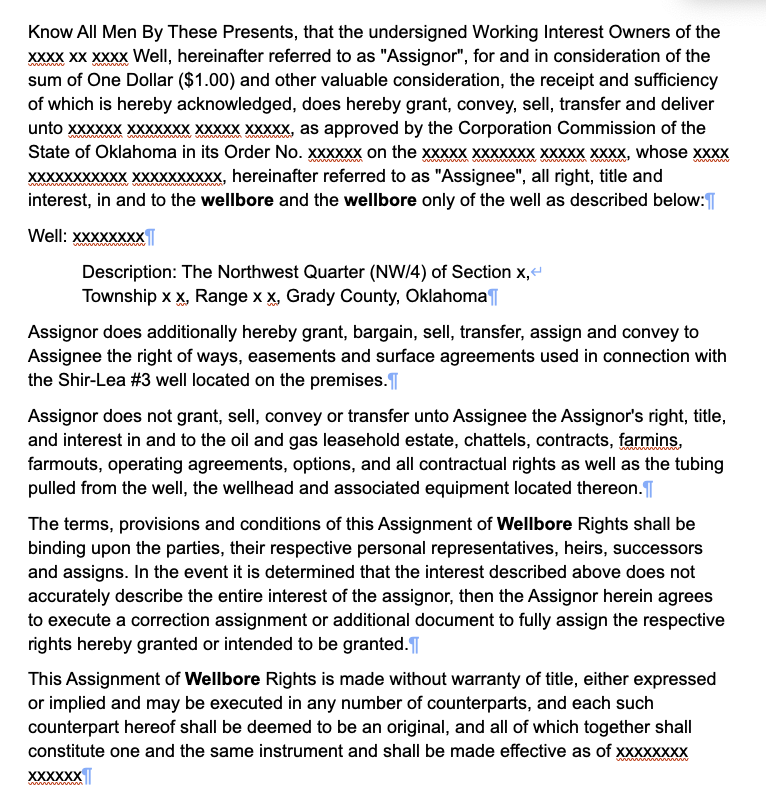
This is for Grady County, Oklahoma. The document talks about selling the wellbore rights. “Wellbore” is a term I had not run across before. If I read the attached section of a VERY long document, the wellbore rights were sold to someone else. I don’t think this means all mineral rights. I THINK it means just whatever is coming out of the well. I have attached a picture of the text involved. I redacted the actual information of where and well name, etc., since I don’t know if including this info is actually needed. I also don’t know if it is a security issue or not considering that the info came from a public document.
Wellbore rights refer to the production related to that specific wellbore only. The assignment will not apply to any other well that is not cited in the assignment.
Thanks. This starts to make a glimmer of sense. So this only transferred the output of Shir-Lea #3 and not any of the others. This makes sense since we receive some few royalties from the other Shir-Lea wells, but not #3.
To all reading this… I am pretty sure autocorrect got me. I wrote “wellbore” and it changed it to “wellborn” and I didn’t see it. In fact, it tried to do it here.
Thanks. As I mentioned elsewhere, there is a case where autocorrect got me multiple times and I didn’t see it. One of these days I will reread before I hit send. Maybe. Or not.
Remember the word wellbore. Wellbore is what operator gets in lease. Wellbore is just a hole in the ground without salable production. All you sell in lease is basic wellbore. No Frac without $25,000 Frac fee. Not included in basic wellbore lease
The lease is for your mineral rights for oil and gas and sometimes other minerals with a primary term as indicated in the clauses. The operator is not required to drill a well unless it specifically says so in the lease. The operator does have the right to sell the liquids from the well if it is producible. The bonus payment is based upon your net mineral acreage.
The “$25,000 Frac fee” is highly unlikely as 95% of wells in the US are going to be fracked anyway as part of normal business operations.. Never heard of such a document until the last few days on the forum and any fee would be related to net mineral acres, not a flat fee. Have any of the landmen on the forum ever dealt with such an item? With hundreds of mineral owners in a spacing unit these days, don’t think an operator would even consider such an option.
It’s happening. They won’t tell you it’s happening. Fracing can just as easily ruin a potential well. Too much risk to not charge for it. It’s a very small percentage of total well costs and the owner is risking his money twice.
The operator is required by law to Frac if that’s what it takes. Yet fracs can and do make it worse. Owner cannot accept the risk of Frac going haywire and voiding the value of minerals.
From GOOGLE AI:
”The term "frack fee" is not a standardized industry term, but typically refers to a fee, tax, or financial assurance that covers the public costs associated with hydraulic fracturing (fracking). These fees are generally paid by the oil and gas companies to state or federal regulatory agencies, or in some cases, directly to landowners or local governments.
What the Fee Covers
“Frack fees” are intended to cover various costs and potential damages associated with the environmental and public health impacts of drilling and fracking operations:
Well Plugging and Reclamation: Ensuring the well site is properly sealed and the land restored after use.
Environmental Damage: Covering the costs of cleaning up contaminated water supplies (groundwater and surface water), soil contamination, and damage to natural resources.
Public Infrastructure Damage: Repairing damage to local roads and other public infrastructure caused by heavy truck traffic and industrial activity.
Victim Compensation: Providing funds to compensate local residents for property damage or health impacts.
Regulatory Oversight: Funding inspections, enforcement of environmental rules, and overall regulatory management.
Who Receives the Payment
The recipients of these payments can vary depending on the specific regulations and agreements in place:
Government Agencies: State and federal regulatory bodies (such as the Office of Natural Resources Revenue in the U.S.) are the primary recipients, using the funds to ensure compliance and cover cleanup costs if a company fails to do so.
Landowners: Landowners typically receive royalties (a percentage of the revenue from the oil and gas produced) rather than a direct “frack fee”. These are negotiated in the lease agreement and are a payment for the right to extract minerals from their land, not a fee for potential damage.
Local Communities/Public: The ultimate beneficiaries of these fees (if adequate) are local communities and taxpayers, who would otherwise be left to absorb the cost of cleanup when companies are unable or unwilling to pay. “
Note that Frack Fee is not a standard term in the industry. If something like it is paid, it usually goes to the state or regulatory agencies. The mineral owner is paid a lease bonus and royalties. That is standard.
The AI stated above is not exactly correct in using the term “landowners” as a catchall term. Mineral owners get the bonus and royalties. Surface owners have a different lease for surface use. Some surface owners may also own minerals if they have not been severed.
Please stick to the topic at hand which was about a wellbore question for a well that was completed in 1982.