CR 312/Rocky Creek area pad is still a go by EOG. This includes the surveys of T. Toby, E. Tribble, Z. Davis, and J. Wood. Just not sure when they will move the rig here. Got some info as I was working with lawyers and EOG on my land/mineral issues, which have now been cleared up for the most part—I have not received official word from someone at EOG that Alfaro and Kenobi will not be done…just heard this from others, who should have heard this from EOG…we shall see. Heard eastern units of Francis pad not as good as Francis was in first weeks. Heard Chapman and Maddox had upper EF thinning out toward the east. Heard they were looking into the “Northwest”….did not get exact area, this could be north of FM 532 between FM 1295 and FM 957, or this could even be the Flatonia/Muldoon area. That is all I got and probably for a while since I don’t think they are very happy with me at the moment.
Interesting about Kenobi and Alfaro. I also heard yesterday from a direct source that EOG hasn’t made a final decision yet and the rig may stay and drill them.
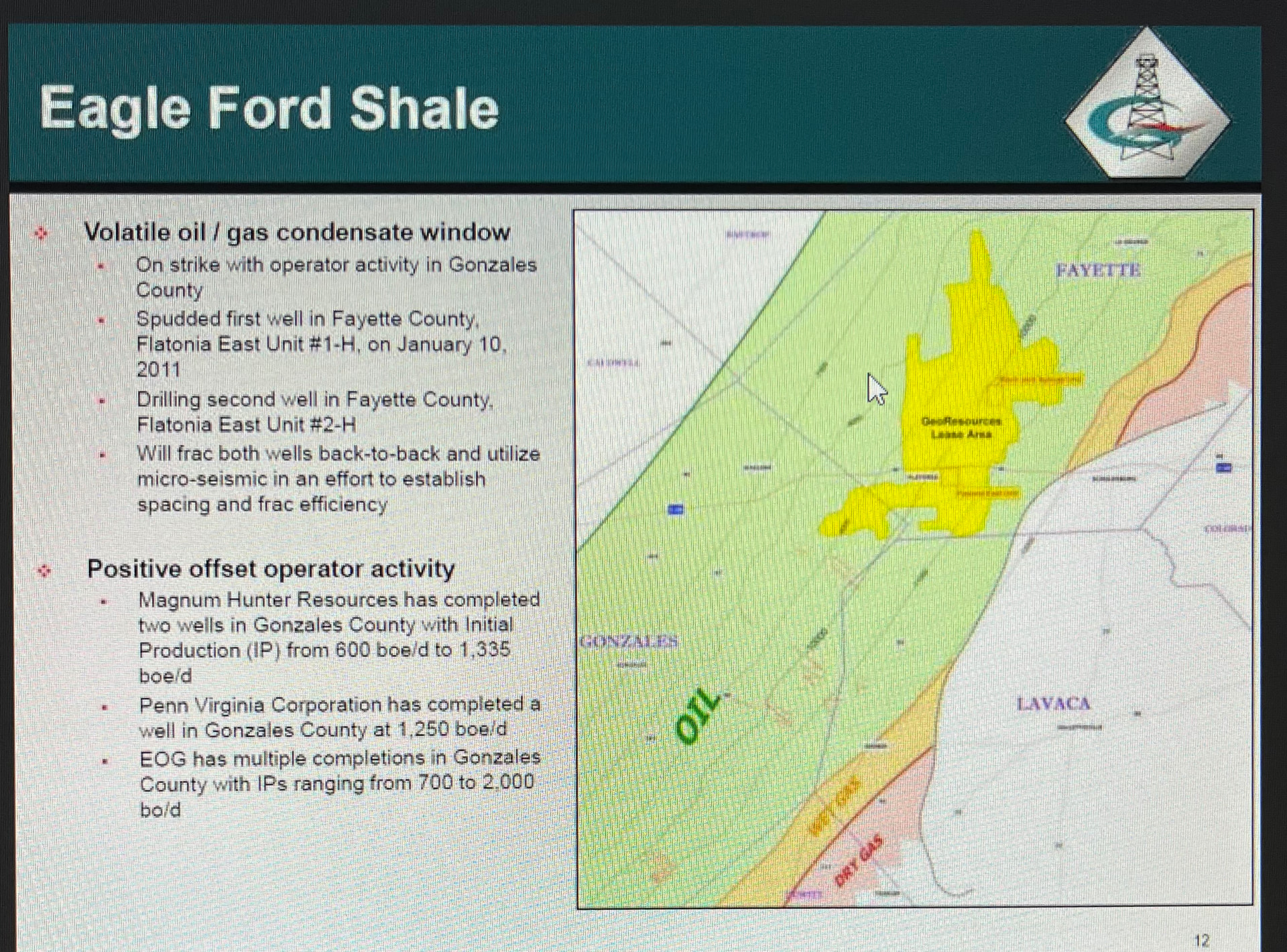
I went back through my old Investors Presentations and found this from GeoResources (not GeoSouthern) in 2011. The area to the lower right was not explained at the time and this is an EF map but thought it may still be of interest,
I thought they were going after the Austin Chalk? Is the Upper Eagle Ford the same as the Austin Chalk in this area? Or is the Austin Chalk and Upper Eagle Ford just thin going east?
As far as those eastern wells that are flowing, how do they compare to Blackshear and Parr?
Sounds like the new gas plant may have less gas to process if the eastern wells are not as good.
I guess time will tell and I am sure things can change.
As I understand it, they are chasing a combination of the Eagle Ford and Lower Austin Chalk via mechanically co-mingling the two zones via fracture stimulation efforts. Eagle Ford is getting very thin in this area - so minimal oil and gas in place. But a well-positioned lateral in the Upper Eagle Ford will allow for fracturing into the Lower Austin Chalk to optimize oil and gas flow and EURs.
Sorry if I muddied the water with the Eagle Ford Shale slide. Mainly wanted to show The Great Unknown to the SE. Here’s hoping the authors were all wet. After all none of those players were exactly fireballs during that timeframe.
Considering the time frame of the 2011 slide, the authors did the best that they could do.
At this time, Austin Chalk was not felt to be a Hz frac target - only a target that could be produced via natural fracturing.
That makes sense. Approximately how thick is the AC in this area? What is considered a good thickness for production?
In addition I have seen wells from the RRC website list the Del Rio or Buda formations on some vertical wells in the area that targeted the Edwards. Is the Del Rio and Buda viable for commercial production? Are they separate formations or are they part of the AC?
The stratigraphic formations here from younger to older are Austin Chalk, Eagle Ford, Maness Shale, Buda Lime, Del Rio Shale, and Georgetown Lime.
Maness and Del Rio are not prospective. Buda and Georgetown are prospective only when natural fractures are present to allow for any O&G (plus water) production from those carbonate intervals.
The Austin Chalk is hundreds of feet thick but it is broken into multiple members with different reservoir properties. The lower Austin Chalk (called either the E or A Member depending on where you are) is the one with reservoir properties (i.e. porosity and perm plus oil in place volumes) that is part of the mechanical co-mingling concept in play here.
See attached 3 slide PDF. Contains a generalized strat column plus isopach (thickness) maps for Upper and Lower Eagle Ford Sections.
Note the thinness of the Lower Eagle Ford in the subject area (25-50’) and non-existence of Upper Eagle Ford section.
Austin Chalk in this area sits directly on top of the Lower Eagle Ford section.
Strat Column_EF Isopachs.pdf (279.0 KB)
Looks like rig #1209 is staying here and the next pad site will be the CR 312 & Rocky Creek. However, the pad is not accessible from CR 312. It will be accessible on CR 306/CR 305. Not that many roads in this neck of the woods. Could not tell you if it is a 2 or a 4 unit pad, but looks to be a 4. This area is south of Francis pad, about 2 miles to the southwest.
I meant CR 306/CR 307, not CR 305 for the next EOG well. Slight typing error.
Sometimes you crack me up. If they get mad at you, well here goes news from the Pecan Pad. Maybe they will get mad at me. Monster starting to look good—19 loads in 4 weeks of crud oil. Really don’t know if that’s good or not. Still getting lots of salt water from Reimers at one tanker on average per hour in 24 hours, of course less on weekends. Monster got our division orders. Anybody hear if 1205 we’ll be coming back to Pecan Pad?
19 oil loads in 4 weeks, only about 3,000 barrels max—100 BOPD, not a very good production rate. One would hope to be seeing several times more than that volume on a daily basis.
One tanker of water per day, not that bad—150 to 160 barrels.
Hope to soon start seeing some production on the Texas RRC site—and future revenue statements should have all the details as to production for each month.
Have not heard anything about Rig #1205 coming back this way as of yet. It looks like we got a reprieve of rig #1209 leaving us… to the Dorado… however, it is possible 1209 could go back to Gonzales back and forth… still some 2025 permits not drilled yet… so EOG has time to prepare pads and plan their strategy. The main goal in 2026 is to finish drilling 1 well/unit to hold land on tracts that would be profitable now and in future years. Drill out was supposed to start in 2027… but it is all based on economics and what other opportunities there are out there… I can see EOG slowing the drill out plan from a 2027/2028 initial plan to a 2027-2030 drill out schedule even with fewer units than planned.
Rock-Man, that’s 1 load an hour, not a day. Good average, 24 loads are a few less in 24 hours. Thanks for all the info from you and M-L.
OK—I misunderstood the frequency (didn’t read as carefully as I should have).
Early post-frac flowback is always water rich—can only store so much on location.
Getting units HBP is the ultimate objective UNLESS some of the early production points to less-than-ideal economics. The production decline here will be the big concern (as is the case with all horizontal frac jobs on these types of unconventional reservoirs).
Milton you should charge us each $5/week for your on the spot reporting. Here’s my question not specifically for you but for everyone.
In these days of multiple wells per pad, how would the casual observer determine whether production is from 1H or 2H? Wouldn’t all output be metered at the wellhead and hauled off after going through the common processing facilities?
This place is great!
Each well on the pad has its own meter - so production volumes are not lumped together for the pad/lease.
This will be reflected in Texas Railroad Commission production filings as well as monthly revenue statements.
It is possible that EOG may apply for “co-mingling” for the lease/pad down the road, but based on their efforts so far in the Eagle Ford trend, I don’t expect this to take place.