Our royalties were averaging around $800 per month from both Cimarex and Chevron for about 4 years, but the past few months have declined to around $350 per month from both operators. However, the offers to buy the mineral rights continue to skyrocket despite these lower royalties.
I do realize that the first 5 years are the most productive for a well (the wells have been in production for about 4 years). For those in the know, is declining production from previously quite stable producing gas wells a general indication of impending drilling/wells to be conducted nearby? I mean, do producers “cap” production a bit on existing wells in order to ready for drilling into another layer, or nearby?
Property specifics detailed below:
43 acres - T1S Block 59 Section 40 A-2297 T and P RR/Shelton AE Well: Street Sense 40 Unit No. 1H
10 acres - T1S Block 59 Section 39 A-2705 T and P RR Well: Stone Street 46 Unit No. 3H
The offers continue to skyrocket because really good wells have been drilled in neighboring sections. I wouldn’t sell that acreage unless I desperately needed cash, and certainly not under $30,000 per NMA.
Declining production is no guarantee that a new well will be drilled across your tract and generally is just a natural part of the well. Sometimes producers will shut in nearby wells during a frac/completion so the pressure doesn’t damage them. But a quick look at your wells says it’s just part of the decline rate.
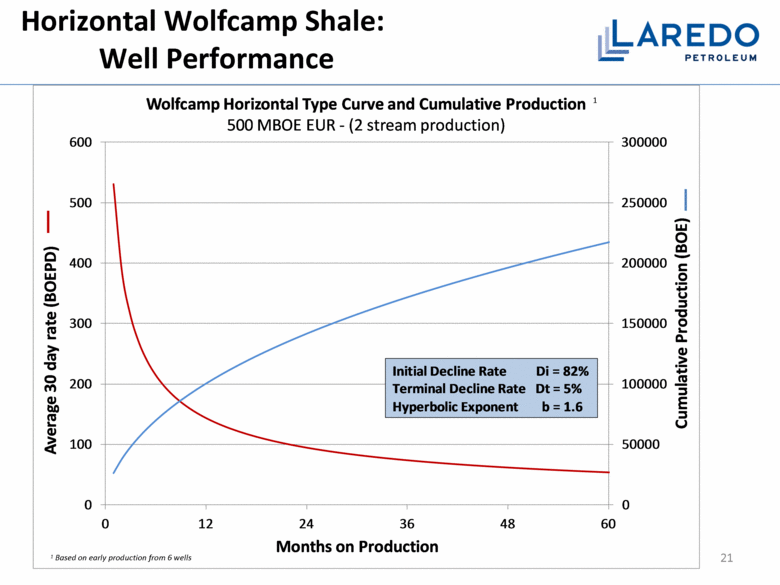
Decline rates for horizontal wells can be 70% in the first year, with another 50% drop the next year, and a long tail end of slower decline. Natural gas production usually drops off a lot slower from horizontal wells than oil production. The Street Sense and Stone Street wells both had very gentle declines on their gas production. For a visual of typical decline rate, see the red line in this graph: http://www.getfilings.com/sec-filings/120326/Laredo-Petroleum-Holdings-Inc_8-K/g79241mmi021.gif
Sorry. I think I went on a bit of a tangent.